October 15, 2026 • By Childing Team
The Son Who Hurried Home: What the Book of Tobit Teaches About Honoring Parents
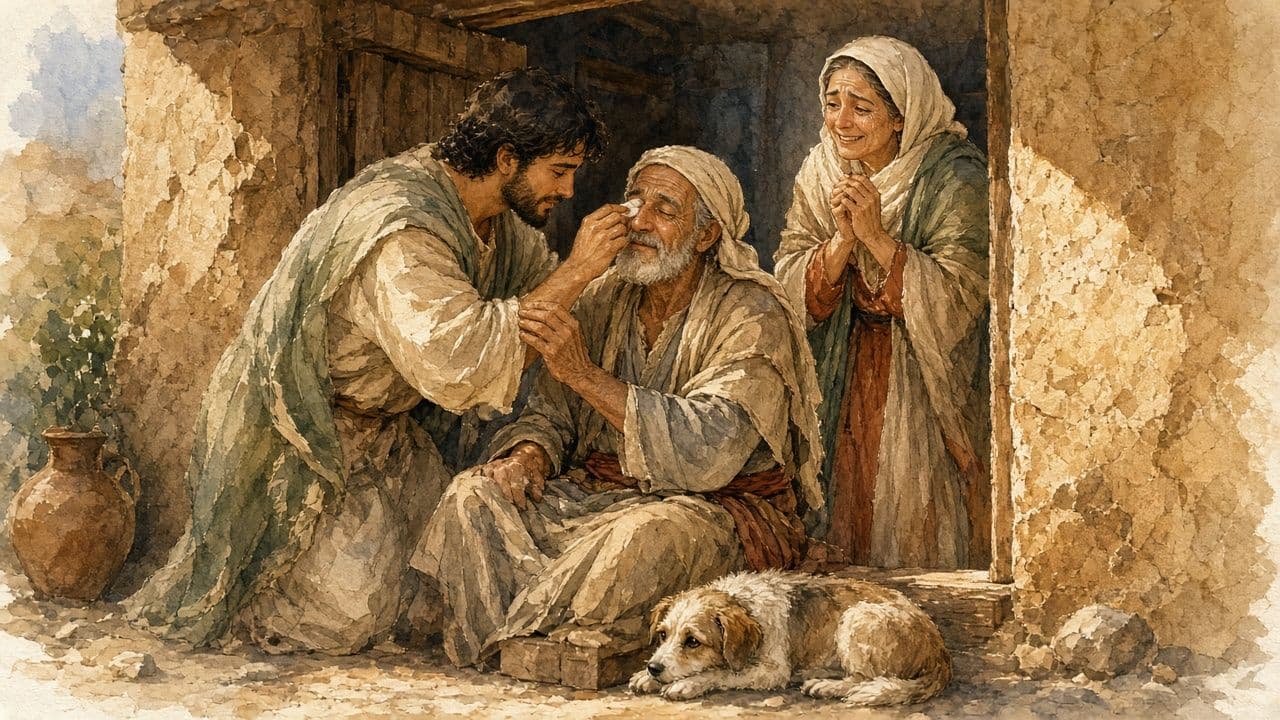
Some stories about honoring parents are grand and heroic. The story of Tobias is quieter. It is about a son who noticed how much his parents were hurting, and who let that change the way he lived.
It comes from the Book of Tobit, found in Catholic and Orthodox Bibles. It is one of the most tender family stories in all of scripture, and it is the heart of our new Christianity: Catholic Tradition cards.
Standing By a Father in His Darkest Season
Tobit was an Israelite living in exile in Nineveh. He was known for his kindness: he fed the hungry, clothed the poor, and, at real risk to himself, buried the bodies of his people when others left them in the street.
Then one night, after burying a man, he lay down by a wall to rest. Droppings from a nest above fell into his eyes, and white films grew over them. Tobit went blind.
What followed was a long, humbling season. The family grew poor. His wife, Anna, worked weaving cloth to keep them fed. Neighbors and even relatives mocked him: where had all his good deeds gotten him? Many of us know some version of this chapter, when a parent who was once strong and capable becomes dependent, and the whole household feels the weight of it.
Receiving a Father's Final Charge
Believing he might soon die, Tobit called his son Tobias and gave him what amounts to a last testament (Tobit 4). It begins with family:
"Thou shalt bury my body: and thou shalt honour thy mother all the days of her life." And then, with a husband's tenderness: "And when she also shall have ended the time of her life, bury her by me."
He reminds Tobias how much his mother suffered for him before he was even born. Then he sends him on an errand. Years before, Tobit had left a sum of money with a relative in the distant land of Media. The family needed it now. The road was long and dangerous, and Tobias was young.
Braving a Dangerous Road for His Family
A traveler offered to guide him, a kind young man who knew the way. Neither Tobias nor his parents knew that this companion was the Archangel Raphael, sent by God in disguise.
Along the Tigris River, a great fish leapt at Tobias. Raphael told him to catch it and keep its gall, heart and liver, because they would be needed. Tobias did not yet understand why. He simply listened.
In Media, Tobias met his kinswoman Sarah, a young woman carrying deep sorrows of her own. With Raphael's help, those sorrows were lifted, and Tobias and Sarah were married.
Putting His Parents' Worry Before His Own Feast
Here comes the moment that makes Tobias a model for every adult child.
Sarah's father, Raguel, was overjoyed and wanted the wedding celebration to go on and on. He begged Tobias to stay longer. It was his own wedding, after all. Who could blame him for staying?
But Tobias said no. In the Douay-Rheims words: "I know that my father and mother now count the days, and their spirit is grievously afflicted within them."
He was right. Back home, Anna had convinced herself that her son was dead. Tobit kept trying to comfort her while worrying himself. Tobias could not see them, but he could imagine them, and that was enough. He chose their peace over his own comfort, and he started home.
Healing His Father's Eyes With His Own Hands
Every day, Anna went out and sat by the road on a hill, watching. One day she saw a figure in the distance and knew at once. She hurried back to tell her husband: "Behold thy son cometh."
The family dog, which had traveled the whole way with Tobias, ran ahead wagging its tail as if bringing the news. Blind Tobit rose and ran toward the door, stumbling, reaching for a servant's hand to guide him. Father and son embraced, and both wept with joy (Tobit 11).
Then Tobias did what Raphael had prepared him for. He took the gall of the fish and gently put it on his father's eyes. After a while, white films began to come away, "like the skin of an egg," and Tobias drew them from his father's eyes with his own hands. Tobit could see. The first thing he saw was his son, and he praised God: "Behold I see Tobias my son."
Caring for Both Families to the Very End
The story does not end with the miracle. Tobias stayed faithful through the long years that followed. When his mother died, he buried her beside his father, just as he had promised.
Then he went to Sarah's parents, now old, and cared for them too. The Douay-Rheims records it plainly: "he found them in health in a good old age: and he took care of them, and he closed their eyes" (Tobias 14). Honoring parents, for Tobias, included the parents he gained through marriage.
Turning Gratitude Into Action
What did Tobias actually do? He entered into his parents' suffering instead of keeping a safe distance from it. He took on a hard journey for the family's sake. He cut his own celebration short because he knew his parents were anxious. And he tended his father's infirmity with his own hands.
None of it was a speech. It was all action. That is what we mean at Childing when we say: say thank you with action.
Honoring Your Parents Like Tobias Today
You probably won't meet an archangel on the road or pull a fish from the Tigris. But Tobias's choices translate into ordinary life:
1. Remember that they count the days. If you've been away, traveling or just busy, your parents notice. Call before they have to wonder.
2. Come home sooner. When you have a choice between lingering elsewhere and getting back to the people waiting for you, choose them sometimes, even at a cost.
3. Step into the hard chapter. If a parent is losing sight, hearing, memory or strength, don't look away. Learn what they are going through and stay close.
4. Use your hands. Drive them to the eye doctor. Organize their medications. Fix the loose step. Practical care is love made visible.
5. Honor your mother all her days. Tobit's charge has no expiration date. Keep showing up, in small ways, for as long as you have her.
6. Keep the promises you made. If a parent has told you their wishes for their last days or their burial, write them down and honor them.
7. Include your in-laws. Tobias cared for Sarah's parents in their old age. Your spouse's parents are part of the family you are called to honor.
Drawing a Card and Sharing Your Story
Tobit's story is now part of our Christianity: Catholic Tradition deck, 20 cards drawn from Sirach and Tobit. Card CAT-010 carries Tobit's charge to honor your mother all the days of her life. Card CAT-020 tells how Tobias cared for his wife's parents in their old age. You can find them, and many more, in the Daily Draw.
Do you have a Tobias moment of your own: a time you came home early, sat at a hospital bedside, or watched a parent's face light up when you walked through the door? We'd love for you to share a tribute on the Childing Tribute Wall. Your story might be the one that sends someone else home a little sooner.